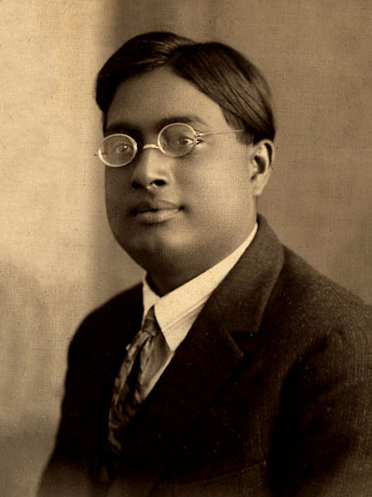
Portrait of Satyendra Nath Bose

Satyendra Nath Bose. Unknown author. Public domain.

Historical person · 20th Century

Satyendra Nath Bose

1894–1974

Indian physicist whose statistical treatment of light helped establish quantum statistics and gave his name to bosons.

Explore Science and TechnologyRead biography ↓

Your next chapter starts here

Take history with you.

Create a free account or log in to download this guide as a PDF. Reading on the website is always free.

Create free account
Quick answers

What to know about Satyendra Nath Bose

Direct answers to common questions about Satyendra Nath Bose, followed by the full sourced biography.

Who was Satyendra Nath Bose?

Indian physicist whose statistical treatment of light helped establish quantum statistics and gave his name to bosons. Indian physicist whose statistical treatment of light helped establish quantum statistics and gave his name to bosons.

What is Satyendra Nath Bose known for?

Satyendra Nath Bose is particularly known for Bose–Einstein statistics, Quantum theory, Science education in Bengali.

When did Satyendra Nath Bose live?

Satyendra Nath Bose lived 1894–1974. This profile places that life within 20th Century and Science and Technology.

Why is Satyendra Nath Bose historically significant?

Bose returned to a long university career and became a professor in Calcutta in 1945. He also supported scientific communication in Bengali, helping make technical discussion less dependent on English. His public and educational work belongs alongside the famous 1924 paper: building audiences, teaching and strengthening institutions were substantial commitments in their own right. He.

Biography

Satyendra Nath Bose: life and legacy

Overview

Indian physicist whose statistical treatment of light helped establish quantum statistics and gave his name to bosons.

Mathematics and teaching in Bengal

Bose studied at Presidency College in Calcutta, excelling in mathematics before entering university teaching. His education connected him with a generation of Indian scientists seeking access to the newest European work without abandoning local intellectual life. At Dhaka, where he became a reader in physics in 1921, teaching advanced students supplied opportunities to reconsider difficult theoretical questions. His career is a reminder that a classroom can be a research setting: explaining a derivation carefully may expose assumptions that its published form leaves hidden or that established practice has ceased to question.

Counting light differently

The problem that made Bose famous concerned Planck’s law for radiation emitted by a heated body. Working with light quanta, he used a way of counting states that treated identical particles as indistinguishable. The resulting calculation recovered the radiation law rather than merely one limiting part of it. This was a conceptual change in the statistical description, not the discovery of a new visible ray. After publication difficulties, Bose sent his paper to Einstein in 1924. Einstein recognised its significance, translated it into German and helped bring it to a wider scientific audience.

From photons to quantum statistics

Einstein extended the treatment to particles with mass, producing ideas associated with Bose–Einstein condensation. The joint name describes a sequence of contributions, not an experiment the two men carried out together. Bose’s international contacts expanded when he travelled to Europe, meeting researchers in Paris and Berlin. The term boson later identified particles obeying the relevant quantum statistics. This connection should not be confused with a claim that Bose personally discovered every particle bearing that classification. His central achievement concerned the rules governing collections of indistinguishable particles and their possible states.

Science beyond a single paper

Bose returned to a long university career and became a professor in Calcutta in 1945. He also supported scientific communication in Bengali, helping make technical discussion less dependent on English. His public and educational work belongs alongside the famous 1924 paper: building audiences, teaching and strengthening institutions were substantial commitments in their own right. He later led Visva-Bharati University and received Royal Society recognition. His broad interests in language, literature and music complicate the image of a scientist concerned only with specialised calculation, while his scientific reputation rests on a specific and durable theoretical advance.
Key moments

Timeline

  1. Born

    Satyendra Nath Bose's life began in 1894.

  2. First degree

    Completes his bachelor’s studies at Presidency College.

  3. Master’s degree

    Finishes advanced mathematical study in Calcutta.

  4. Dhaka appointment

    Begins teaching physics at the newly established university.

  5. Paper sent to Einstein

    Presents his derivation of Planck’s radiation law using light quanta.

  6. Berlin visit

    Meets Einstein during his period of European research leave.

  7. Science Congress leadership

    Serves as general president of the Indian Science Congress.

  8. Calcutta professorship

    Returns to Calcutta University for the next phase of his career.

  9. Visva-Bharati leadership

    Becomes vice-chancellor after retiring from his Calcutta chair.

  10. Royal Society election

    Receives fellowship recognition for his scientific contributions.

  11. Died

    Satyendra Nath Bose died in 1974.

Connections

Related people

Keep reading

Related stories

Test your knowledge

Related quizzes

Evidence

Sources and further reading

  1. S. N. Bose ArchiveS. N. Bose National Centre for Basic Sciences
  2. Satyendranath BoseUniversity of St Andrews, MacTutor
  3. Bose, Satyendra NathBanglapedia, Asiatic Society of Bangladesh
  4. Biographical records and portraitsNational Portrait Gallery
  5. Historical people and primary sourcesLibrary of Congress
  6. Historical figuresEncyclopaedia Britannica

Biographical claims are summarised from the sources above. Interpretation and disputed reputations are identified in the text rather than presented as settled fact.

Milestone unlocked!

Your completed quizzes are building a history of their own.

