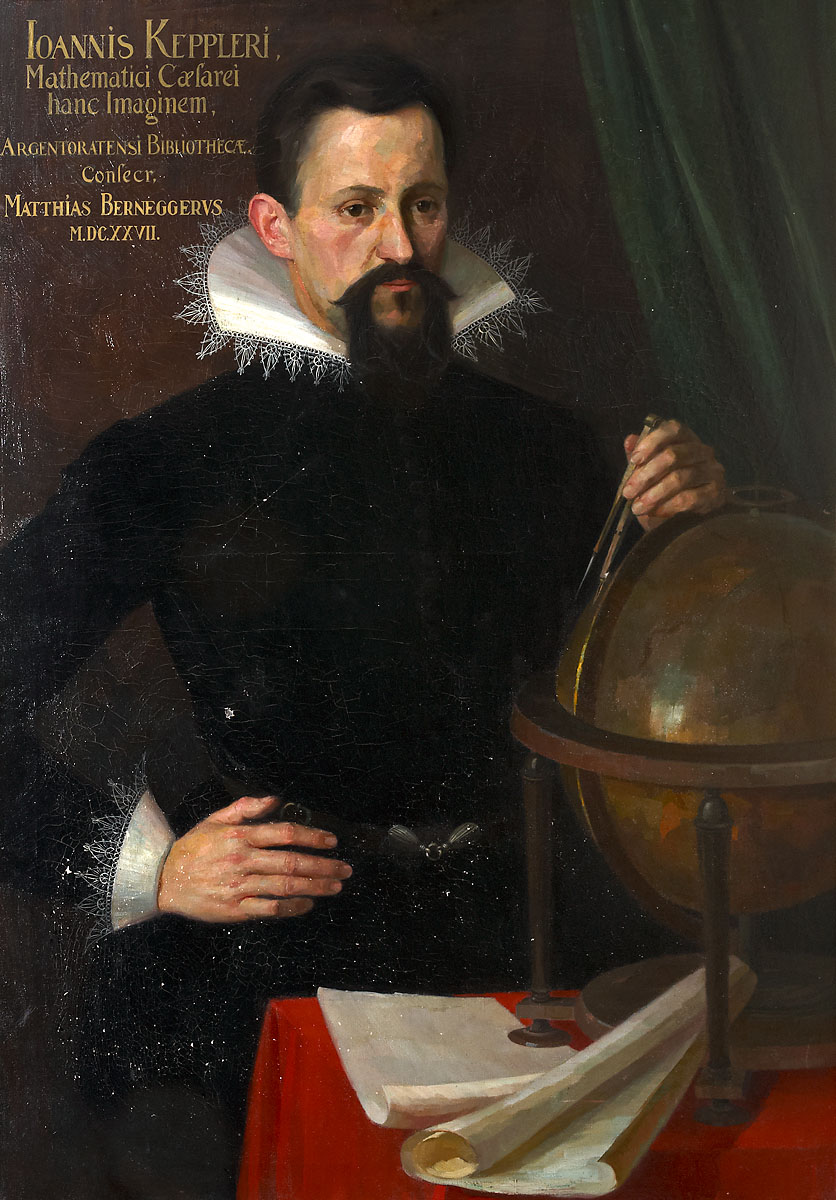
BiographyJohannes Kepler: life and legacy
Overview
Astronomer who used Tycho Brahe’s observations to establish elliptical planetary orbits and mathematical relationships governing their motion.
From theology to astronomy
Johannes Kepler studied at Tübingen, where Michael Maestlin introduced him to Copernican astronomy. He initially intended a theological career but accepted a mathematics teaching position in Graz in 1594. His early cosmological work sought a geometrical order underlying the arrangement of the planets. Religious conviction was part of that search: he believed mathematical investigation could reveal the structure of creation. He also produced calendars and astrological predictions as professional work. These activities belonged to the same historical career, even though modern readers distinguish sharply between astronomy, astrology and theology.
The importance of Tycho’s measurements
Kepler moved to work with Tycho Brahe in 1600 and succeeded him as imperial mathematician after Tycho’s death the following year. The relationship was difficult, but the observational records were crucial. Mars in particular resisted satisfactory explanation by the inherited combinations of circular motion. Kepler took the mismatch between calculation and observation seriously rather than dismissing it as an inconvenience. Astronomia Nova in 1609 presented two results: planets follow ellipses with the Sun at one focus, and the line connecting a planet to the Sun sweeps equal areas in equal times. Planetary speed therefore changes along the orbit.
A relationship across the planets
The third law, published in Harmonices Mundi in 1619, connected the time taken to complete an orbit with the orbit’s size. In modern wording, the square of the orbital period is proportional to the cube of the semimajor axis. This linked different planetary motions through one mathematical relationship. The laws described motion with remarkable effectiveness, but they were not Newton’s later theory of universal gravitation. Keeping that distinction clear preserves Kepler’s actual achievement: he found patterns that a later physical theory would explain, rather than already possessing the entire explanation himself.
Optics, tables and persistence
Kepler’s work extended well beyond the three laws. Investigations of vision and lenses contributed to optics, while mathematical studies considered shapes, volumes and the packing of spheres. His Rudolphine Tables, published in 1627, made improved astronomical predictions available to other users and helped demonstrate the practical strength of the new astronomy. Religious conflict and insecure employment complicated his life, as did the legal case against his mother, whom he defended against an accusation of witchcraft. The surviving correspondence reveals sustained calculation, argument and revision rather than a single effortless moment of discovery.