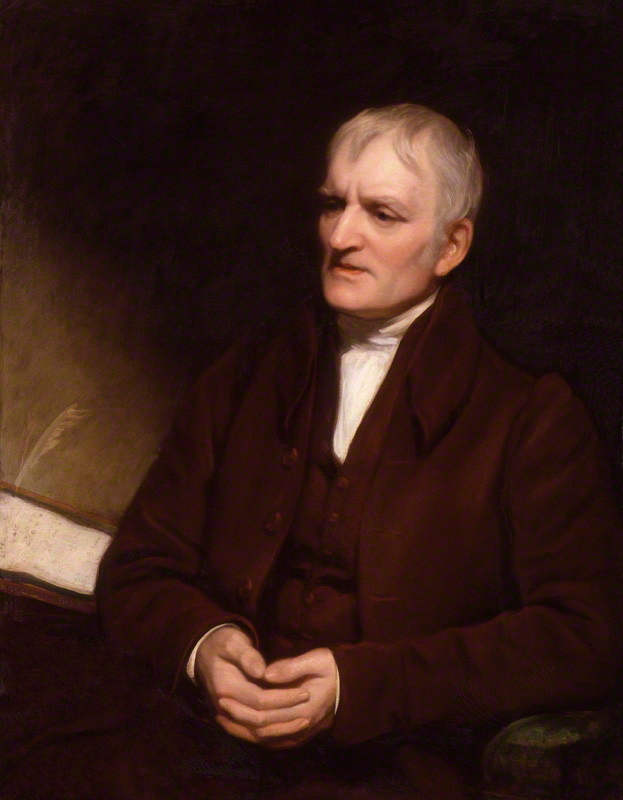
BiographyJohn Dalton: life and legacy
Overview
Manchester teacher and investigator whose atomic theory connected chemical combination with the relative weights of atoms, alongside sustained research into weather and colour vision.
A teacher who kept observing
Dalton came from a Quaker family in Eaglesfield, Cumberland, and began teaching while still young. In Kendal, the scholar John Gough encouraged his interests in mathematics and the weather. He began a daily meteorological record in 1787 and maintained the practice for the rest of his life. This patient accumulation of observations was as characteristic of his work as the atomic theory for which he became famous. Moving to Manchester in 1793 brought him into a larger intellectual community, where teaching, public lectures and discussion supported investigation outside the modern research-university system.
Giving atoms a chemical purpose
Ancient thinkers had discussed atoms, but Dalton’s contribution was to connect an atomic model with measurable chemical relationships. If elements consisted of characteristic atoms, compounds could be understood as combinations of them in simple numbers. Relative atomic weights then offered a way to relate the model to laboratory quantities. His developing ideas appeared in lectures and papers before the publication of A New System of Chemical Philosophy in 1808. The theory was useful because it made chemical composition intelligible and comparable, not because Dalton had directly seen individual atoms through an instrument.
Important ideas could still contain errors
Dalton’s assumptions about the simplest combinations sometimes produced incorrect formulas and weights. He treated water as a combination of one hydrogen atom and one oxygen atom rather than the two-to-one relationship used today. This was not a trivial spelling mistake: deciding how many atoms were present affected the numerical system built around them. Later work revised those details while retaining the power of an atomic account of chemical combination. The history is therefore more revealing than a story in which a single discovery immediately delivers a complete modern theory. Evidence, conventions and competing interpretations continued to matter.
Colour vision and Manchester’s scientific community
Dalton also investigated his own difficulty distinguishing colours. His explanation, involving the material within the eye, proved wrong, but he arranged for his eyes to be examined after death rather than shielding the idea from testing. The Manchester Literary and Philosophical Society provided an audience, facilities and an institutional home; he became its president in 1816. Private teaching helped sustain his livelihood, and James Prescott Joule was among his pupils. These connections show how scientific knowledge developed through local communities as well as famous publications. Dalton’s varied interests resist reducing an entire working life to a diagram of differently sized atoms.