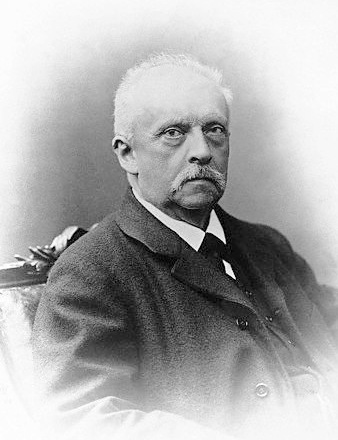
Portrait of Hermann von Helmholtz

Hermann von Helmholtz. Unknown artist. Public domain.

Historical person · 19th Century

Hermann von Helmholtz

1821–1894

Physician and physicist who connected energy conservation, the study of the senses and precise measurement, and developed the ophthalmoscope for examining the living eye.

Explore Science and TechnologyRead biography ↓

Your next chapter starts here

Take history with you.

Create a free account or log in to download this guide as a PDF. Reading on the website is always free.

Create free account
Quick answers

What to know about Hermann von Helmholtz

Direct answers to common questions about Hermann von Helmholtz, followed by the full sourced biography.

Who was Hermann von Helmholtz?

Physician and physicist who connected energy conservation, the study of the senses and precise measurement, and developed the ophthalmoscope for examining the living eye. Physician and physicist who connected energy conservation, the study of the senses and precise measurement, and developed the ophthalmoscope for examining the living eye.

What is Hermann von Helmholtz known for?

Hermann von Helmholtz is particularly known for Conservation of energy, Ophthalmoscope, Physiological optics.

When did Hermann von Helmholtz live?

Hermann von Helmholtz lived 1821–1894. This profile places that life within 19th Century and Science and Technology.

Why is Hermann von Helmholtz historically significant?

His 1863 study of the sensations of tone connected vibration, hearing and musical experience. Alongside these investigations he worked on fluid motion, electricity and the mathematical foundations of physics. Posts at Königsberg, Bonn and Heidelberg preceded his move to a Berlin physics chair in 1871. His range can seem unusually broad today, but the connections were concrete:.

Biography

Hermann von Helmholtz: life and legacy

Overview

Physician and physicist who connected energy conservation, the study of the senses and precise measurement, and developed the ophthalmoscope for examining the living eye.

Medicine as a route into science

Hermann Helmholtz was born in Potsdam into a teacher’s family with limited financial resources. He wanted to study physics, but military medical training offered financial support unavailable for his preferred route. He therefore trained as a doctor in Berlin and served in the Prussian army while continuing scientific research. His medical background was not a diversion from his later discoveries. Questions about muscle, nerves and sensation encouraged him to investigate how living bodies could be understood through physical and chemical processes rather than an unexplained force unique to life.

Energy and the living body

In 1847 Helmholtz published an important argument for the conservation of energy. He considered different physical processes together, including motion, electricity and the activity of muscles. Energy that seemed to disappear could change form rather than vanish. He was one contributor to a wider nineteenth-century development that also involved Joule and other researchers, not the solitary inventor of the idea. His approach linked philosophical arguments about the impossibility of producing work from nothing with mathematical descriptions. It helped make the study of organisms part of a broader programme of physical investigation.

Seeing inside the eye

Helmholtz developed the ophthalmoscope around 1850–51, making it possible to illuminate and examine the retina in a living eye. Its importance was practical: doctors could investigate structures previously hidden during ordinary examination. Earlier researchers had explored related optical principles, and later ophthalmologists improved the instrument. The familiar clinical tool therefore grew through a sequence of designs rather than remaining unchanged. Helmholtz also investigated colour vision and the processes through which people interpret visual information. His work treated seeing as an active physiological process, not simply a picture arriving unchanged in the mind.

Sound, perception and physical theory

His 1863 study of the sensations of tone connected vibration, hearing and musical experience. Alongside these investigations he worked on fluid motion, electricity and the mathematical foundations of physics. Posts at Königsberg, Bonn and Heidelberg preceded his move to a Berlin physics chair in 1871. His range can seem unusually broad today, but the connections were concrete: instruments made sensations measurable, and physical theories helped explain what the instruments recorded. He also examined how experience shapes perception. His legacy includes both particular discoveries and a model of research moving between laboratory measurement, mathematics and questions about human knowledge.
Key moments

Timeline

  1. Born

    Hermann von Helmholtz's life began in 1821.

  2. Medical grant

    Received support for military medical training.

  3. Energy conservation

    Published his argument on the conservation of force.

  4. Königsberg

    Became professor of physiology.

  5. Ophthalmoscope

    Developed and described an instrument for examining the living retina.

  6. Bonn appointment

    Moved to a chair of anatomy and physiology.

  7. Heidelberg

    Became professor of physiology at Heidelberg.

  8. Sensations of tone

    Published his major work connecting hearing and music.

  9. Berlin physics

    Moved to a physics professorship in Berlin.

  10. Died

    Hermann von Helmholtz died in 1894.

Connections

Related people

Keep reading

Related stories

Test your knowledge

Related quizzes

Evidence

Sources and further reading

  1. Hermann von HelmholtzUniversity of St Andrews, MacTutor
  2. Hermann von HelmholtzStanford Encyclopedia of Philosophy
  3. Helmholtz, Hermann vonAmerican Academy of Ophthalmology
  4. OphthalmoscopeNational Museum of American History
  5. Biographical records and portraitsNational Portrait Gallery
  6. Historical people and primary sourcesLibrary of Congress
  7. Historical figuresEncyclopaedia Britannica

Biographical claims are summarised from the sources above. Interpretation and disputed reputations are identified in the text rather than presented as settled fact.

Milestone unlocked!

Your completed quizzes are building a history of their own.

