BiographyGeorge Stephenson: life and legacy
Overview
Colliery engineer who helped turn steam railways into practical transport systems through locomotive development, surveying and railway construction.
Engineering from the coalfield
George Stephenson was born at Wylam in Northumberland, where his father worked with a colliery pumping engine. His early employment placed him among the machinery, repairs and practical problems of coal production. He learned through work rather than a university engineering course. By 1812 he had responsibility for machinery at Killingworth. Mines needed to move heavy loads cheaply and consistently; this commercial problem encouraged improvements to engines, wheels and tracks. Stephenson’s importance grew from making these interconnected parts function reliably, rather than from inventing steam power in isolation.
Locomotives, lamps and collaboration
In 1814 Stephenson built the locomotive Blücher for Killingworth colliery. Subsequent work sought better traction and smoother running on imperfect rails. He also developed a miners’ safety lamp in 1815, leading to a bitter priority dispute with Humphry Davy. These projects illustrate the overlap between mining and railway engineering. In 1823 George helped establish Robert Stephenson and Company at Newcastle. His son Robert became central to the firm’s technical work. Recognising the younger Stephenson’s contribution avoids attributing every machine produced by the company to George alone.
Building a railway, not just an engine
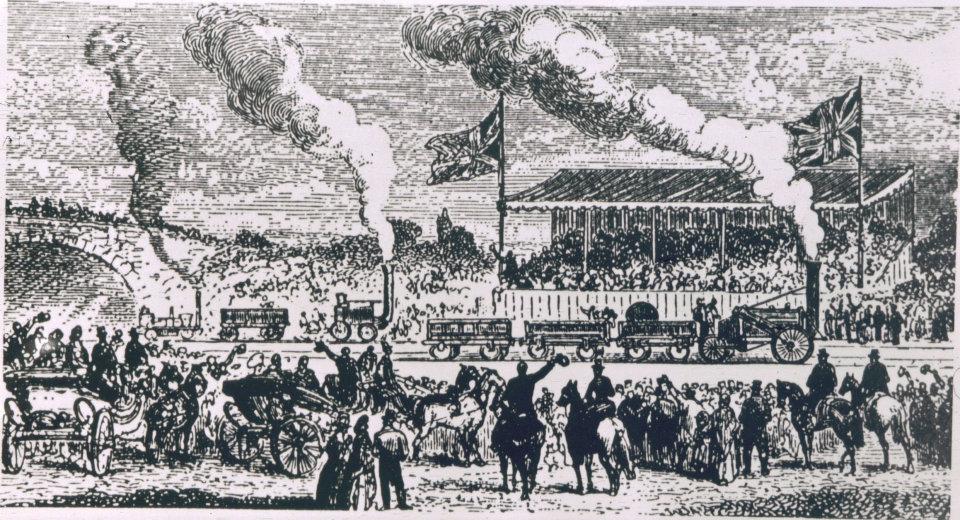
Stephenson became engineer to the Stockton and Darlington Railway, which opened in 1825. Locomotion No. 1 hauled the celebrated opening train, but early operations combined different forms of traction and did not instantly resemble a modern passenger service. The Liverpool and Manchester Railway posed another challenge: a busy inter-city route needed dependable locomotives, manageable gradients and substantial civil engineering. Rocket, built under Robert’s direction, won the Rainhill Trials in 1829. The competition helped demonstrate that locomotives could provide the line’s regular motive power, rather than stationary engines hauling vehicles by cables.
Expansion and the limits of a heroic label
After the Liverpool and Manchester opening in 1830, Stephenson advised and engineered further lines across industrial Britain. Route selection mattered because steep gradients could severely limit the loads early locomotives carried. Railways also demanded finance, parliamentary authority, land acquisition and large labour forces. Calling Stephenson the father of railways is therefore a shorthand for a major contribution, not proof that he created the system single-handedly. Earlier inventors, his son, workshop workers and investors all mattered. In 1847 he became the first president of the Institution of Mechanical Engineers; he died at Tapton House near Chesterfield the following year.