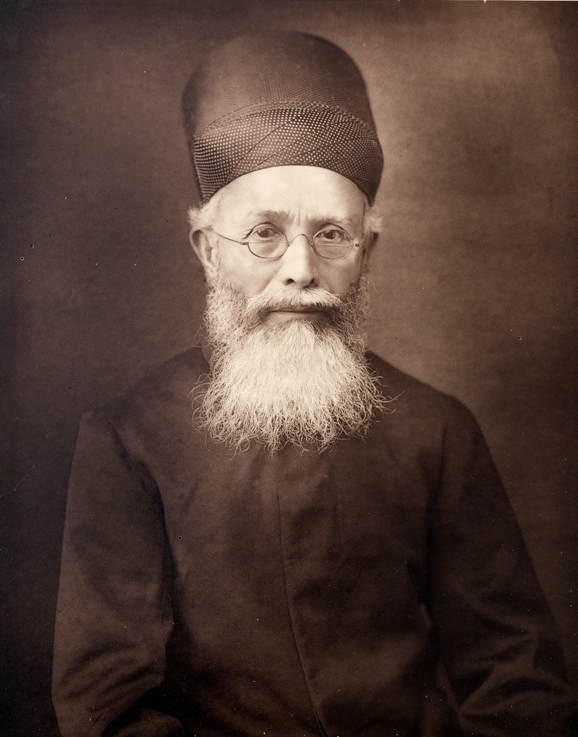
Portrait of Dadabhai Naoroji

Dadabhai Naoroji. Unknown artist. Public domain.

Historical person · 19th Century

Dadabhai Naoroji

1825–1917

Indian nationalist and British MP whose economic critique argued that colonial rule transferred wealth out of India and helped perpetuate poverty.

Explore Indian HistoryRead biography ↓

Your next chapter starts here

Take history with you.

Create a free account or log in to download this guide as a PDF. Reading on the website is always free.

Create free account
Quick answers

What to know about Dadabhai Naoroji

Direct answers to common questions about Dadabhai Naoroji, followed by the full sourced biography.

Who was Dadabhai Naoroji?

Indian nationalist and British MP whose economic critique argued that colonial rule transferred wealth out of India and helped perpetuate poverty. Indian nationalist and British MP whose economic critique argued that colonial rule transferred wealth out of India and helped perpetuate poverty.

What is Dadabhai Naoroji known for?

Dadabhai Naoroji is particularly known for Drain of wealth theory, Central Finsbury MP, Poverty and Un-British Rule in India.

When did Dadabhai Naoroji live?

Dadabhai Naoroji lived 1825–1917. This profile places that life within 19th Century and Indian History.

Why is Dadabhai Naoroji historically significant?

Naoroji was an important figure in the Indian National Congress and served as its president on three occasions. By the 1906 session he endorsed self-government as the movement’s goal. His long career connected early constitutional petitioning with a more assertive national demand. Younger activists could disagree with his methods while drawing on his economic analysis. He died in 1917..

Biography

Dadabhai Naoroji: life and legacy

Overview

Indian nationalist and British MP whose economic critique argued that colonial rule transferred wealth out of India and helped perpetuate poverty.

Education, reform and public life

Dadabhai Naoroji was born into a Parsi family in Bombay and studied at Elphinstone College. Teaching, commercial work and community reform all formed part of his early career. He promoted education and participated in debates about social and religious change. Travel between India and Britain later gave him access to audiences on both sides of imperial government. His politics relied heavily on evidence, public meetings and associations. This was not a retreat from nationalism: he believed that exposing contradictions in British claims of just government could create pressure for substantial change.

Explaining the drain of wealth

Naoroji argued that India’s poverty could not be understood simply as a failure of local effort or resources. Payments to officials abroad, remitted profits and the costs of imperial administration transferred wealth out of the country. His drain theory connected economic statistics to the political structure of colonial rule. Poverty and Un-British Rule in India, published in 1901, gathered this critique into a major work. Particular estimates can be debated, but the central intervention was powerful: empire had to be assessed by the resources it removed, not only by the improvements its supporters claimed it provided.

An Indian representative at Westminster

In 1892 Naoroji won election as Liberal MP for Central Finsbury, overcoming racial hostility during his campaigns. He served until 1895. Parliament gave him a platform to question Indian expenditure and unequal access to public employment, while he also represented the concerns of his London constituency. His presence challenged assumptions about who could speak within British political institutions. It did not mean that those institutions readily accepted his arguments. Electoral success was a practical foothold within an imperial system whose distribution of power he continued to criticise.

From reform towards self-government

Naoroji was an important figure in the Indian National Congress and served as its president on three occasions. By the 1906 session he endorsed self-government as the movement’s goal. His long career connected early constitutional petitioning with a more assertive national demand. Younger activists could disagree with his methods while drawing on his economic analysis. He died in 1917. His significance lies in showing how budgets, salaries and trade could be political questions: the language of accountancy became a way to challenge the legitimacy of an empire.
Key moments

Timeline

  1. Born in Bombay

    Born on 4 September.

  2. College teaching

    Began teaching at Elphinstone College.

  3. East India Association

    Founded an organisation to discuss Indian affairs in Britain.

  4. Congress presidency

    Presided over the second Congress session.

  5. Elected to Parliament

    Won Central Finsbury as a Liberal.

  6. Left the Commons

    Lost his seat at the general election.

  7. Economic critique published

    Published Poverty and Un-British Rule in India.

  8. Self-government demand

    Presided over Congress as it endorsed swaraj.

  9. Died

    Dadabhai Naoroji died in 1917.

Connections

Related people

Keep reading

Related stories

Test your knowledge

Related quizzes

Evidence

Sources and further reading

  1. Dadabhai NaorojiEnglish Heritage
  2. The man who brought statistics into politicsPress Information Bureau, Government of India
  3. Historical representation in the CommonsHouse of Commons Library
  4. Naoroji: Congress careerIndian National Congress
  5. Biographical records and portraitsNational Portrait Gallery
  6. Historical people and primary sourcesLibrary of Congress
  7. Historical figuresEncyclopaedia Britannica

Biographical claims are summarised from the sources above. Interpretation and disputed reputations are identified in the text rather than presented as settled fact.

Milestone unlocked!

Your completed quizzes are building a history of their own.