The Tang dynasty ruled China from 618 to 907, with an interruption when Wu Zetian proclaimed her own Zhou dynasty. It inherited the reunification achieved under the Sui and developed an influential imperial order. Its capitals attracted travellers and traders, while poets and artists produced works that later generations continued to admire. The period was neither uniformly peaceful nor consistently open to outsiders. Military expansion, religious patronage and rebellion altered the balance of power. Looking beyond the description of a golden age reveals a changing society connected to wider Asian networks and vulnerable to major internal conflicts.

Topic guide
Tang Dynasty
Government, international exchange, poetry and upheaval in China between 618 and 907, including Wu Zetian and the An Lushan rebellion.
Start here
Overview
Key questions answered
Tang Dynasty explained
Begin with clear answers, then use the full guide, timeline, people, stories and quizzes below.
What is Tang Dynasty?
Government, international exchange, poetry and upheaval in China between 618 and 907, including Wu Zetian and the An Lushan rebellion. The Tang dynasty ruled China from 618 to 907, with an interruption when Wu Zetian proclaimed her own Zhou dynasty. It inherited the reunification achieved under the Sui and developed an influential imperial order. Its capitals attracted travellers and.
When did Tang Dynasty happen?
The guide follows major developments from 618 (Tang dynasty founded) to 907 (Tang dynasty ends). The full chronology below explains the changes between them.
What should you know about Tang Dynasty?
The essential areas are Governing an extensive empire, A capital connected with other societies, Wu Zetian and competing forms of authority, Poetry, images and printed devotion, Rebellion and the dynasty's long aftermath. Each section below explains the evidence and historical connections.
Why does Tang Dynasty matter?
The Tang dynasty ruled China from 618 to 907, with an interruption when Wu Zetian proclaimed her own Zhou dynasty. It inherited the reunification achieved under the Sui and developed an influential imperial order. Its capitals attracted travellers and traders, while poets and artists produced works that later generations continued to admire. The period was neither uniformly peaceful nor.
Build your understanding
The essential guide
Governing an extensive empire
Li Yuan founded the dynasty in 618, and his son Taizong became emperor in 626. The Tang built on institutions developed under earlier rulers rather than creating government from nothing. Officials, laws and systems of appointment helped link the court with provincial administration. Examinations became increasingly important, but influential families continued to matter; it would be misleading to describe officeholding as immediately open on equal terms to everyone. The capital at Chang'an was both an administrative centre and a place where imperial power could be displayed. Maintaining that power required revenue, communications and military resources across considerable distances, making the relationship between the court and regional commanders a persistent political concern.
A capital connected with other societies
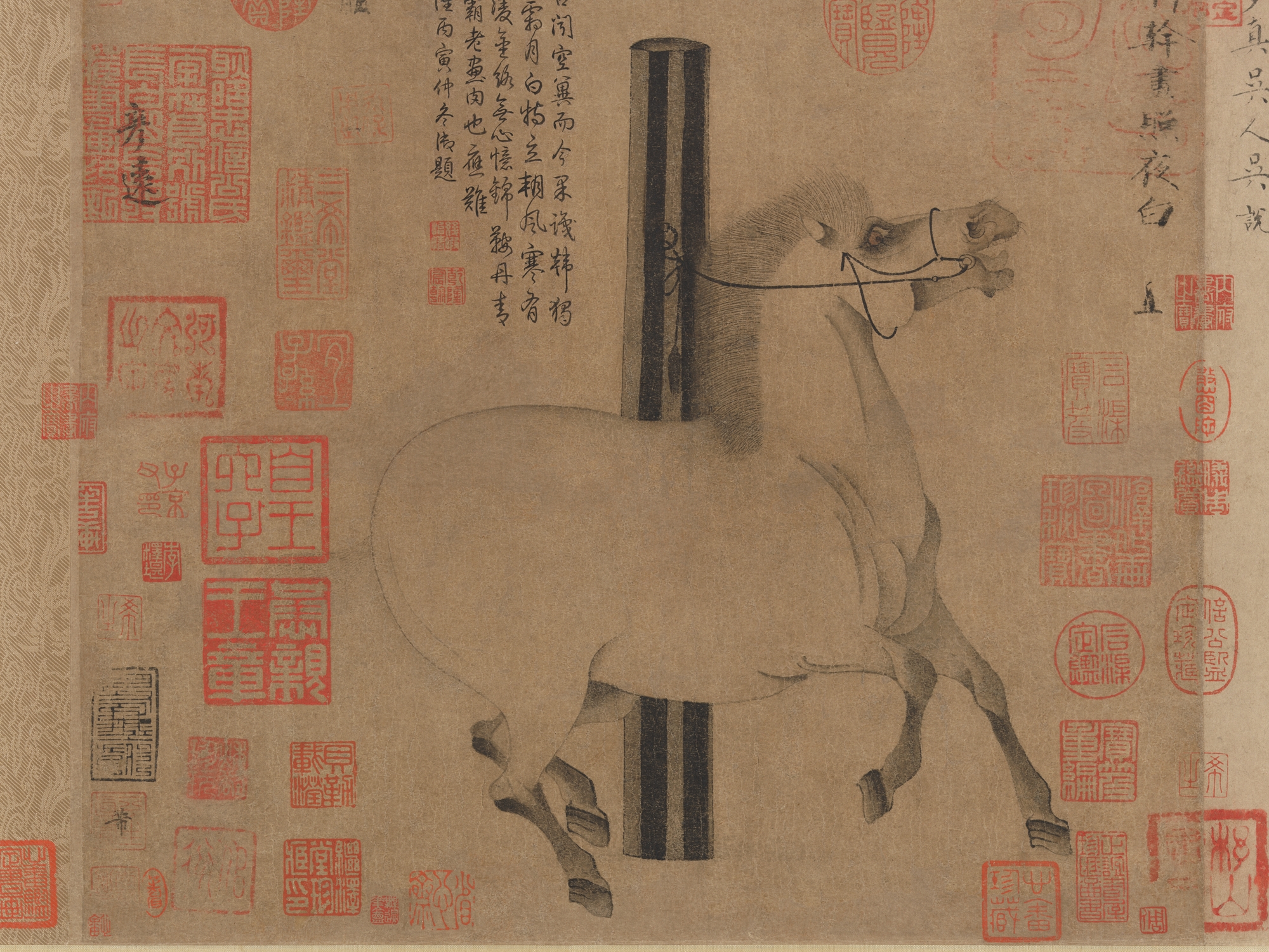
Chang'an participated in networks linking East, Central, South and West Asia. Traders and visitors brought goods, religious ideas and artistic practices, while overland exchanges depended on many intermediaries rather than one continuous journey by a single merchant. Central Asian camels and horses became familiar subjects in funerary sculpture. Horses had military importance as well as associations with elite status, so their appearance in art connects exchange with the practical requirements of imperial power. Ceramic figures cannot be read as photographs of everyday streets, but their subjects reveal the interests of patrons and makers. The Tang world was shaped by these encounters, not isolated from developments beyond China's political boundaries.
Wu Zetian and competing forms of authority
Wu Zetian rose through the imperial court before ruling in her own name between 690 and 705. She called her dynasty Zhou, interrupting Tang rule rather than simply acting as an emperor's consort throughout her career. Her position demonstrates both the possibilities of court politics and how exceptional female possession of the imperial title remained. Religious patronage formed part of the period's political culture, and Buddhism had an important place in society. It coexisted with other traditions rather than replacing them entirely. Understanding Wu requires attention to institutions and alliances as well as personality. Later accounts were shaped by attitudes towards a woman exercising authority normally claimed by men.
Poetry, images and printed devotion
Li Bai and Du Fu became two of the best-known poets associated with the Tang, while painters and calligraphers developed traditions later generations studied and reinterpreted. Surviving objects also reveal religious practices beyond famous literary names. A printed Diamond Sutra dated 11 May 868 was preserved at Dunhuang; its colophon records Wang Jie's sponsorship. The scroll shows how printing could serve Buddhist devotion and the circulation of sacred texts. It should not be described as proof that printing itself was invented on that date. Its survival is especially valuable because dated objects anchor broad accounts of cultural achievement in particular acts of production, sponsorship and use by people whose names would otherwise be less familiar.
Rebellion and the dynasty's long aftermath
The An Lushan rebellion began in 755 and continued until 763. It inflicted severe suffering and weakened the court's position, changing relationships between central authority and military power. Dramatic casualty totals sometimes repeated from population records are unreliable, because missing registrations also reflect displacement and administrative breakdown. The dynasty nevertheless survived for roughly another century and a half, so the rebellion was not its immediate end. Political fragmentation and further upheavals eventually culminated in 907. Tang influence continued through literature, visual culture and institutions, including connections with neighbouring societies. Its history therefore includes both extraordinary cultural production and the costs of maintaining, challenging and losing imperial authority over a large and diverse population.
Chronology
Key dates
Tang dynasty founded
Li Yuan establishes a new imperial house.
Taizong becomes emperor
His reign helps consolidate Tang power.
Wu Zetian proclaims Zhou
She rules in her own name under a new dynastic title.
Tang rule restored
Wu's Zhou dynasty ends.
An Lushan rebels
A major military uprising begins.
Rebellion ends
The conflict leaves lasting political and social damage.
Diamond Sutra printed
Wang Jie sponsors the dated Buddhist scroll.
Tang dynasty ends
The imperial house falls after prolonged weakening.
Read more
Essential stories
Begin with the foundations, then move into the events, people and debates that add detail and complexity.
No verified stories have been assigned to this topic yet.
Test yourself
Available quizzes
People
Events
No events are currently assigned.
Continue learning
Sources and further reading
- Metropolitan Museum: Tang dynasty
- Smithsonian: Chinese history timeline
- Metropolitan Museum: Tang horse and rider
- University of Washington: Camel trader
- British Library IDP: Library Cave objects
- Oxford Bibliographies: An Lushan rebellion
- Library of Congress: exhibitions and primary-source collections
- Heilbrunn Timeline of Art History
- British Library: research collections