The Kingdom of Benin developed in what is now southern Nigeria, with its capital at Benin City. It should not be confused with the modern Republic of Benin farther west. Its history is closely associated with the Edo people, the oba or monarch, and skilled court workshops. Oral traditions, artworks and written accounts provide different kinds of evidence about its past. European trade became significant without creating the kingdom itself. The British invasion of 1897 destroyed its political independence and dispersed royal objects, but neither Edo society nor the monarchy's cultural importance ended with that conquest.

Topic guide
Benin Kingdom
The Edo kingdom's monarchy, court arts and trade, the British invasion of 1897, and the continuing history of its cultural heritage.
Start here
Overview
Key questions answered
Benin Kingdom explained
Begin with clear answers, then use the full guide, timeline, people, stories and quizzes below.
What is Benin Kingdom?
The Edo kingdom's monarchy, court arts and trade, the British invasion of 1897, and the continuing history of its cultural heritage. The Kingdom of Benin developed in what is now southern Nigeria, with its capital at Benin City. It should not be confused with the modern Republic of Benin farther west. Its history is closely associated with the Edo people, the oba or monarch, and skilled.
When did Benin Kingdom happen?
The guide follows major developments from Around the tenth century (Ogiso traditions) to 2022 (Smithsonian transfers ownership). The full chronology below explains the changes between them.
What should you know about Benin Kingdom?
The essential areas are Origins, kingship and political organisation, Trade and the reign of Ewuare, What the court arts recorded, The conquest of 1897, Restoration and the question of return. Each section below explains the evidence and historical connections.
Why does Benin Kingdom matter?
The Kingdom of Benin developed in what is now southern Nigeria, with its capital at Benin City. It should not be confused with the modern Republic of Benin farther west. Its history is closely associated with the Edo people, the oba or monarch, and skilled court workshops. Oral traditions, artworks and written accounts provide different kinds of evidence about its past. European trade.
Build your understanding
The essential guide
Origins, kingship and political organisation
Edo traditions describe an earlier line of rulers called the Ogiso and connect the later oba dynasty with Oranmiyan and Ife. These accounts carry historical and cultural significance, but approximate early dates should not be presented as a complete contemporary written chronology. By the period associated with Ewuare in the fifteenth century, the kingdom was expanding and reorganising royal authority. The oba worked within a political order involving chiefs and court associations rather than ruling through personal commands alone. Ritual duties were central to kingship. The monarchy's connection with ancestors and the well-being of the community helped explain why objects used at court possessed significance beyond their material value or decorative appearance.
Trade and the reign of Ewuare
Ewuare's reign, beginning around 1440, is associated with important developments in the kingdom's power and court organisation. Portuguese contact later in the fifteenth century connected Benin with new trading relationships. Imported materials such as coral and brass acquired local meanings within an already developed political culture. Royal control over valuable goods helped support authority, while images of foreigners entered court art. Exchange did not mean that European visitors understood the institutions they encountered. Nor should foreign materials obscure Edo craftsmanship and decisions about how objects were used. Benin's history is therefore better understood as interaction between societies than as a story in which artistic or political sophistication arrived from outside.
What the court arts recorded
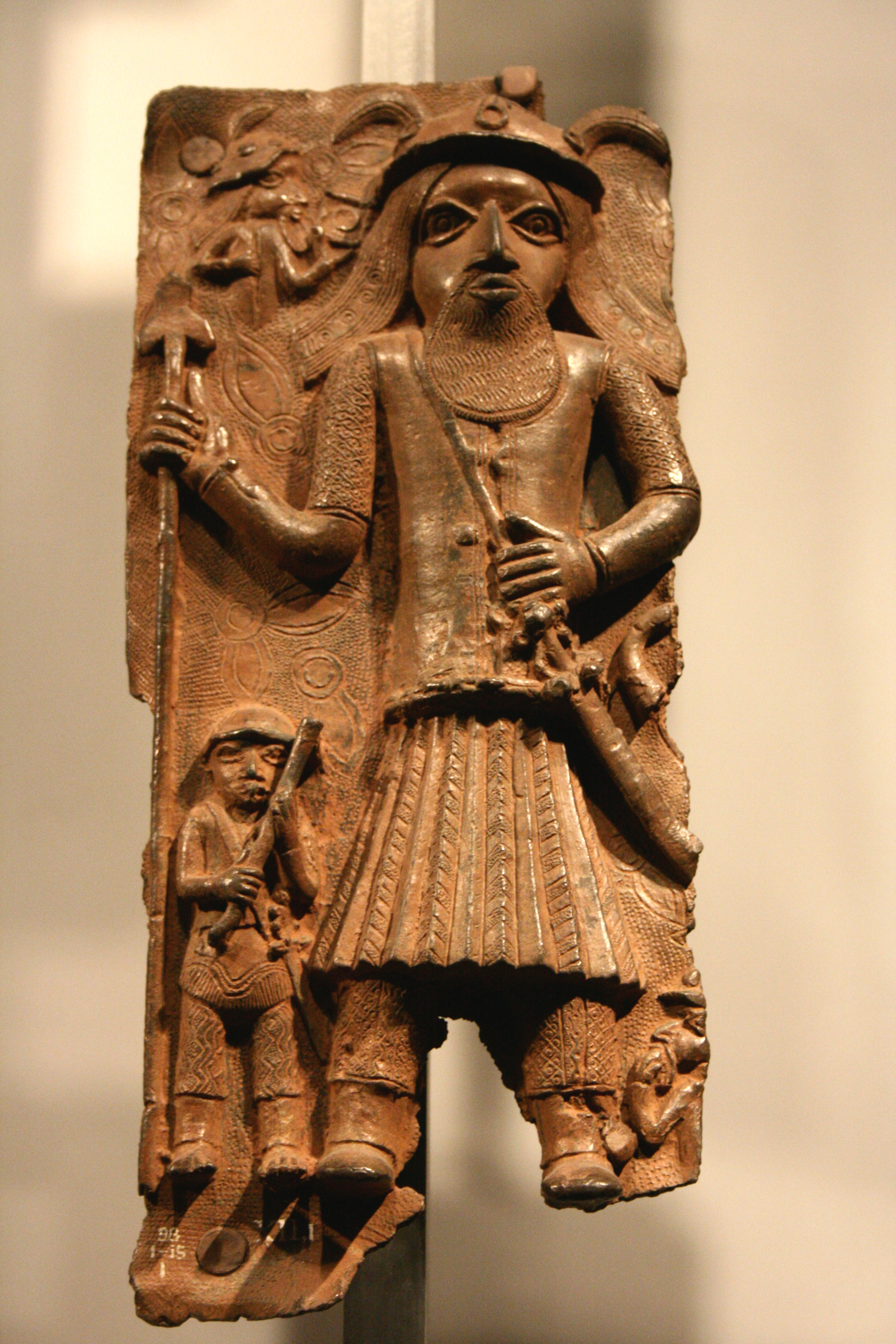
Metalworkers, ivory carvers and other specialists produced objects connected with royal ceremony, memory and status. Commemorative heads honoured deceased rulers, but they are not straightforward portrait likenesses in the modern photographic sense. Plaques and other works represented people and relationships important to the court. The familiar phrase Benin Bronzes covers a varied group of objects, many made of brass rather than bronze. Materials, scale and symbols communicated rank and authority. Removing these works from their original settings also removed connections with ceremonies and oral knowledge. Studying technique alongside function helps explain why they were more than isolated masterpieces and why their displacement remains a matter of historical and cultural concern.
The conquest of 1897
Relations with Britain deteriorated amid disputes over trade and expanding colonial ambitions. In 1897 a British-led delegation was attacked on its way to Benin City. Britain then sent a large military force that invaded the capital, removed Oba Ovonramwen and sent him into exile. Royal objects were seized and dispersed, including through sales intended to recover expedition costs. Museums and private collectors acquired many of them. Describing this merely as an encounter between collectors and artworks conceals the violence that made their removal possible. The conquest disrupted the court and the political order, while the objects' later display often separated admiration for Edo craftsmanship from recognition of the circumstances in which they had been taken.
Restoration and the question of return
Eweka II was crowned in 1914 after his father's death in exile, restoring the monarchy within a colonial system that restricted its power. New commissions and renewed rituals helped rebuild court life, showing that artistic traditions continued rather than ending in 1897. The return of some coral regalia in 1938 was significant to the royal family and Edo community. More recent restitution debates concern ownership, historical responsibility and access to cultural heritage. In 2022 the Smithsonian transferred ownership of twenty-nine Benin objects to Nigeria. Such returns form part of a continuing process, not a single completed settlement. The kingdom's history remains connected to living institutions and communities as well as museum collections abroad.
Chronology
Key dates
Ogiso traditions
Edo accounts describe an early ruling dynasty.
Oba dynasty develops
Traditions connect its origins with Oranmiyan and Ife.
Ewuare begins his reign
Royal power and court organisation expand.
Portuguese contact
New overseas trading relationships develop.
British invasion
The capital is conquered and royal objects dispersed.
Eweka II crowned
The monarchy is restored with restricted powers.
Coral regalia returned
Some objects associated with Ovonramwen return to Benin.
Smithsonian transfers ownership
Twenty-nine Benin objects are returned to Nigerian ownership.
Read more
Essential stories
Begin with the foundations, then move into the events, people and debates that add detail and complexity.
No verified stories have been assigned to this topic yet.
Test yourself
Available quizzes
People
No people are currently assigned.
Events
No events are currently assigned.
Continue learning
Sources and further reading
- National Museums Scotland: Benin court arts and history
- Art Institute of Chicago: Ewuare and the Portuguese
- Cambridge Museum of Archaeology and Anthropology: Benin
- Pitt Rivers Museum: Kingdom of Benin
- Art Institute of Chicago: Conquest and restoration
- Smithsonian: Return of twenty-nine Benin objects
- Library of Congress: exhibitions and primary-source collections
- Heilbrunn Timeline of Art History
- British Library: research collections