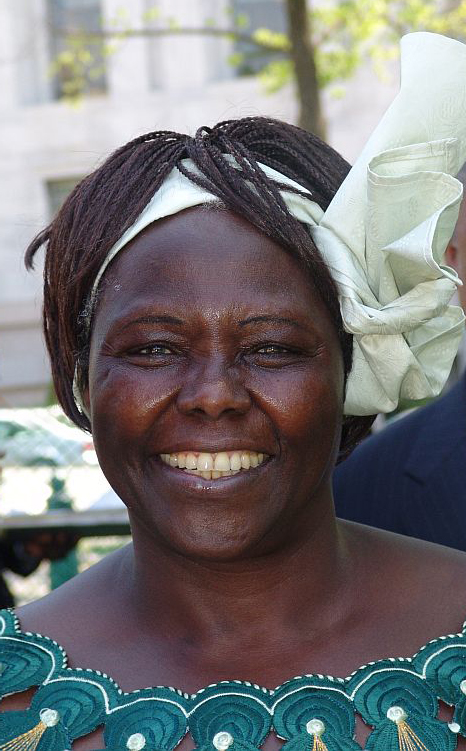
Portrait of Wangari Maathai

Wangari Maathai. Kingkongphoto & www.celebrity-photos.com. CC BY-SA 2.0.

Historical person · 20th–21st centuries

Wangari Maathai

1940–2011

Kenyan scientist and environmental organizer who connected tree planting with women’s livelihoods and democratic participation.

Explore Environmental HistoryRead biography ↓

Your next chapter starts here

Take history with you.

Create a free account or log in to download this guide as a PDF. Reading on the website is always free.

Create free account
Quick answers

What to know about Wangari Maathai

Direct answers to common questions about Wangari Maathai, followed by the full sourced biography.

Who was Wangari Maathai?

Kenyan scientist and environmental organizer who connected tree planting with women’s livelihoods and democratic participation. Kenyan scientist and environmental organizer who connected tree planting with women’s livelihoods and democratic participation.

What is Wangari Maathai known for?

Wangari Maathai is particularly known for The Green Belt Movement, Community-led environmental protection.

When did Wangari Maathai live?

Wangari Maathai lived 1940–2011. This profile places that life within 20th–21st centuries and Environmental History.

Why is Wangari Maathai historically significant?

Maathai’s academic formation crossed several countries before she built her career in Kenya. She completed biological-sciences studies in Kansas in 1964 and a master’s degree in Pittsburgh in 1966, then pursued doctoral research in Germany and Nairobi. Her doctorate followed in 1971. In 1976 she became chair of veterinary anatomy, preceding her appointment as associate professor. These.

Biography

Wangari Maathai: life and legacy

Overview

Kenyan scientist and environmental organizer who connected tree planting with women’s livelihoods and democratic participation.

Science and grassroots conservation

Wangari Maathai built a scientific career in veterinary anatomy and became the first woman in East and Central Africa to earn a doctorate. In 1977 she founded the Green Belt Movement, creating a practical response to environmental damage experienced by rural households. Tree planting became a way to address depleted resources while involving women directly in conservation. The movement connected ecological repair with everyday needs rather than treating forests as separate from human livelihoods.

Environment as a public question

Maathai argued that environmental protection depended on rights, public accountability, and opportunities for communities to influence decisions. Her activism therefore extended beyond planting into democratic participation and women’s empowerment. The 2004 Nobel Peace Prize recognized the connection between sustainable development, democracy, and peace, making her the first African woman to receive that award. Named a United Nations Messenger of Peace in 2009, she continued advocating on environmental and climate issues until her death in 2011.

An international scientific education

Maathai’s academic formation crossed several countries before she built her career in Kenya. She completed biological-sciences studies in Kansas in 1964 and a master’s degree in Pittsburgh in 1966, then pursued doctoral research in Germany and Nairobi. Her doctorate followed in 1971. In 1976 she became chair of veterinary anatomy, preceding her appointment as associate professor. These milestones show that her environmental organizing grew alongside a demanding scientific career. They also illuminate the institutional barriers she confronted before tree planting made her a widely recognized public figure.

Key moments

Timeline

  1. Born

    Wangari Maathai's life began in 1940.

  2. Biological sciences degree

    Graduated from Mount St Scholastica College in Kansas before continuing scientific study in Pittsburgh.

  3. Master's degree

    Completed postgraduate study at the University of Pittsburgh before doctoral work in Germany and Kenya.

  4. Doctorate at Nairobi

    Earned a doctorate at the University of Nairobi, where she taught veterinary anatomy.

  5. Department chair

    Became chair of veterinary anatomy at Nairobi, a significant appointment before her environmental movement took shape.

  6. Founded the Green Belt Movement.

  7. Became an associate professor at the University of Nairobi.

  8. Received the Nobel Peace Prize.

  9. Became a United Nations Messenger of Peace.

  10. Died in Kenya.

Test your knowledge

Related quizzes

Evidence

Sources and further reading

  1. Wangari Maathai: biography and researchun.org
  2. Wangari Maathai: biography and researchnelsonmandela.org
  3. Wangari Maathai: biography and researchnobelpeaceprize.org
  4. Wangari Maathai: biography and researchgreenbeltmovement.org
  5. Biographical records and portraitsNational Portrait Gallery
  6. Historical people and primary sourcesLibrary of Congress
  7. Historical figuresEncyclopaedia Britannica

Biographical claims are summarised from the sources above. Interpretation and disputed reputations are identified in the text rather than presented as settled fact.

Milestone unlocked!

Your completed quizzes are building a history of their own.