BiographyHokusai: life and legacy
Overview
Edo-period painter, illustrator and print designer whose landscapes and drawing books made everyday activity and changing natural forms subjects of extraordinary invention.
An artist in the publishing city
Hokusai worked in Edo, the enormous urban centre now called Tokyo. He entered the studio of Katsukawa Shunshō in 1778 and initially designed actor prints within the commercial world of ukiyo-e. Over his long career he used numerous artistic names and worked in many formats. Illustrated books, privately commissioned prints, paintings and landscape series required different relationships with patrons and publishers. A woodblock print was also a collaborative product: the designer supplied an image that specialist carvers and printers translated into repeated impressions. Hokusai’s fame should not erase those other skilled workers.
Drawing an abundant world
The Hokusai Manga, first published in 1814, assembled drawings of bodies, occupations, animals, landscapes and imaginary beings. The title does not mean that these books were modern narrative comics. Their appeal lies in variety and observation: a bent back, a gust of wind or an awkward movement can become the centre of attention. Hokusai also illustrated popular literature and experimented with different pictorial traditions. His work combines the discipline of repeatable design with a restless interest in how forms change, move and relate to one another.
Fuji and the famous wave
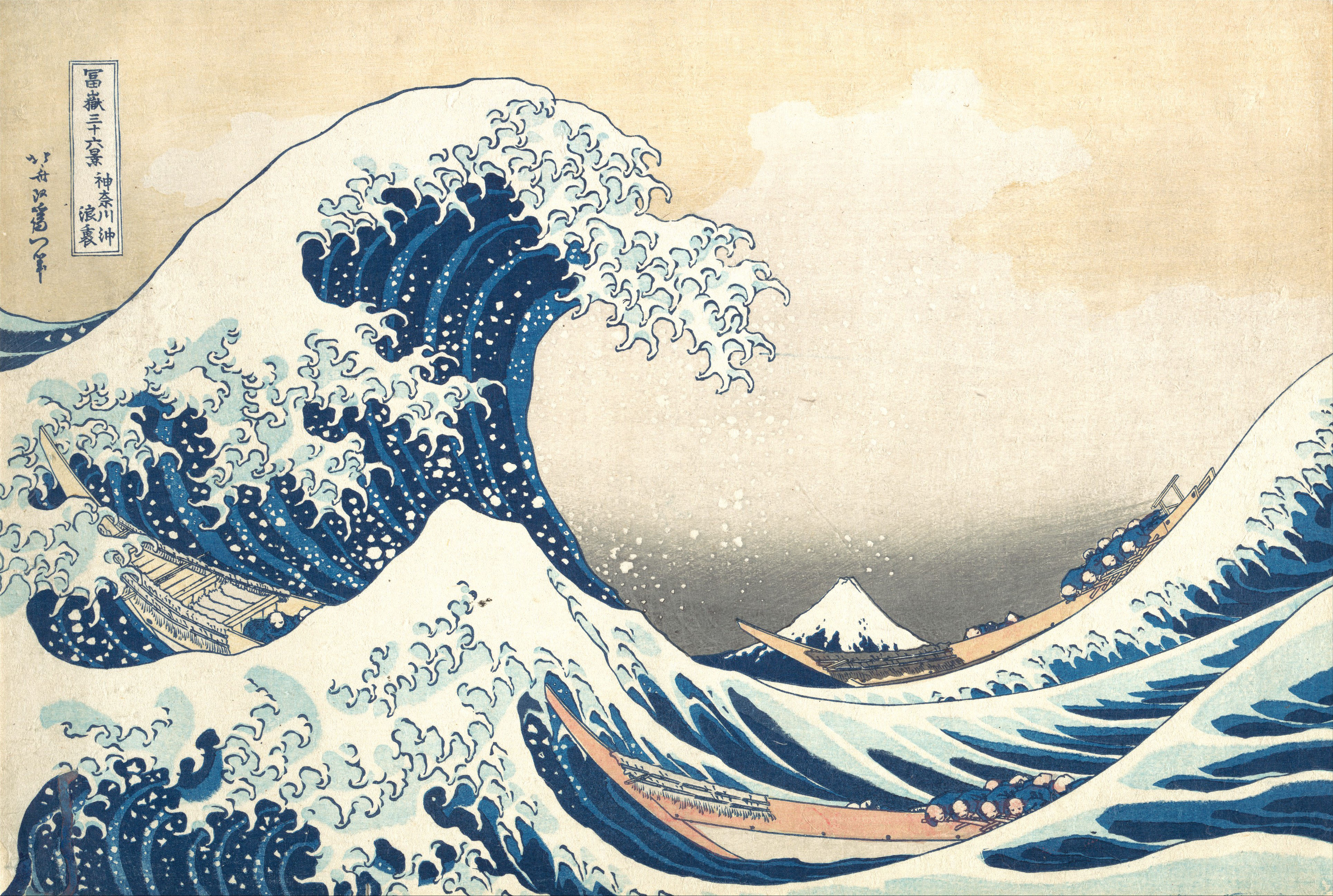
Thirty-six Views of Mount Fuji began appearing around 1830–1831 and eventually included additional designs. The mountain supplies a recurring anchor while workers, travellers, water and weather transform the foreground. In the Great Wave, small boats and their crews lie beneath an immense curling form while Fuji appears distant and compact. Strong outlines and carefully separated areas of colour make the scene instantly readable, but its balance is more subtle than a simple picture of danger. Different scales connect human labour, changing water and the apparently stable mountain.
Late work and international reception
Hokusai continued producing ambitious work into his eighties, including paintings and drawings for a projected illustrated book. His daughter Ōi, herself an artist, belonged to the working and domestic environment of his later years. He died in 1849, before Japanese prints became a major influence on European artists through nineteenth-century collecting and trade. That later reception helped make him internationally famous, but his original audiences and publishing conditions were Japanese. Understanding both contexts avoids treating his work merely as a prelude to European modernism or reducing a varied career to a single wave.