Introduction
On 7 September 1940, German bombers attacked London's docks and nearby streets, beginning the Blitz. Civilians faced nightly raids, destroyed homes and uncertainty about their safety.1 Photographs and propaganda presented an image of Britain standing together against German bombing. This became central to the idea of a 'People's War', in which everyone supposedly shared the same dangers and sacrifices.2 However, the reality was more complicated. As Calder argues, the familiar story of Blitz courage was selective rather than entirely false.3 Differences in shelter provision, homelessness and the resources available to wealthier civilians reveal how class continued to shape wartime experiences.4 Nevertheless, cooperation among ordinary Londoners also demonstrated genuine solidarity.5
Shelter and Social Class
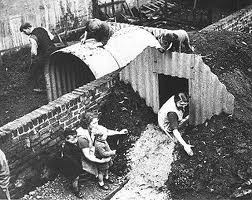
German raids particularly affected the East End, where docks and factories stood beside densely populated working-class streets.6 Yet protection was uneven. Field explains that government policy favoured small shelters built in private gardens, while households living in flats often depended on communal shelters. Some were badly constructed or overcrowded.7 Although Anderson shelters were supplied free to poorer households, they were of little use to people without gardens.8 The family garden shelter shown in (Fig. 1) therefore represents only one wartime experience. It demonstrates the advantages of having a private garden, something many working-class Londoners living in flats lacked. It was not simply a matter of choice: the layout of London's housing helped determine who could shelter privately.
BBC People's War recollections reveal how shelter experiences differed. Daisy, from a terraced house in Deptford, recalled sleeping almost every night in her family's Anderson shelter. Although water seeped inside and the benches were uncomfortable, it offered privacy.9 Jean Jeffries recalled an Underground station, where ‘the only privacy was a blanket suspended from the top bunk’. Even visiting the toilet meant taking the family and their belongings. When her family obtained an Anderson shelter, she described it as ‘luxury after the Tube’.10 These accounts demonstrate differences in comfort, sanitation and privacy. Although civilians faced the same bombing, their living conditions were far from equal.
Homelessness and Unequal Support
Shelters were only part of the problem. Titmuss examines how bombing left families homeless and exposed weaknesses in government emergency arrangements.11 On 9 October 1940, the government acknowledged that 25,500 people had been staying in London's emergency rest centres at their busiest.12 Intended for short stays, these centres became overcrowded as families struggled to find somewhere else to live. Conditions were poor, with limited washing facilities and privacy.13 In contrast, wealthier Londoners could use their resources and connections to secure hotel accommodation or leave the capital. Many working-class families lacked these options and depended on public facilities.14 Although bombing threatened all classes, its consequences were harder for those with fewer resources.
Protest and Cooperation
Class differences were particularly clear on 14 September 1940, when working-class Londoners from Stepney entered the Savoy Hotel's comfortable air-raid shelter in protest. Led by Communist activist Phil Piratin, they wanted to highlight poor shelter conditions in the East End compared with those available to wealthy guests.15 Although Piratin may have emphasised the protest’s success because of his personal involvement, his account demonstrates how working-class Londoners actively challenged unequal shelter conditions.16
However, these difficulties also encouraged cooperation. Field records how people using public shelters formed committees and appointed leaders to demand better sanitation, sleeping arrangements and food. Their efforts helped secure improvements from local authorities.17 This demonstrates that wartime solidarity was genuine, but it was not always the cheerful endurance presented in propaganda. Instead, Londoners worked together to challenge poor conditions and demand fairer treatment.
A People's War?
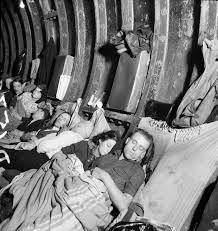
Brandt's photograph of people sleeping together in Liverpool Street Underground (Fig. 2) captures shared vulnerability. Yet Brandt was commissioned by the Ministry of Information, and such pictures could reinforce an image of universal resilience.18 The documentary London Can Take It! similarly celebrated civilian courage for audiences overseas.19 Both reflected genuine endurance, but neither showed the full range of experiences. The Blitz brought people together, yet wealth and housing still shaped their chances of safety. The 'People's War' was therefore a powerful ideal, rather than a completely equal reality.
Test what you know about Second World War
Continue exploring with a related quiz and explanations for each answer.
Bibliography
Primary sources
- House of Commons Debates, 9 October 1940, vol. 365, cols 408–09
- Imperial War Museums, ‘London Can Take It’, film no. COI 943 (1940), https://film.iwmcollections.org.uk/record/392 [accessed 7 November 2026]
- Jeffries, Jean, ‘From London to Bampton – a Wartime Childhood’, BBC WW2 People's War, https://www.bbc.co.uk/history/ww2peopleswar/stories/11/a3441511.shtml [accessed 4 November 2026]
- Piratin, Phil, Our Flag Stays Red (London: Thames Publications, 1948)
- Purkiss, Daisy, ‘Daisy’s War: Deptford during the Blitz’, transcribed by Harrysgirl, BBC WW2 People's War, 9 November 2003, https://www.bbc.co.uk/history/ww2peopleswar/stories/74/a1997274.shtml [accessed 4 November 2026]
Secondary sources
- Bell, Amy Helen, London Was Ours: Diaries and Memoirs of the London Blitz (London: I.B. Tauris, 2008)
- Calder, Angus, The Myth of the Blitz (London: Jonathan Cape, 1991)
- Clapson, Mark, The Blitz Companion: Aerial Warfare, Civilians and the City since 1911 (London: University of Westminster Press, 2019)
- Field, Geoffrey, ‘Nights Underground in Darkest London: The Blitz, 1940–1941’, International Labor and Working-Class History, 62 (2002), pp. 11–49
- Hammett, Jessica, and Henry Irving, ‘Renegotiating Citizenship through the Lens of the “People’s War” in Second World War Britain’, The English Historical Review, 138.594–595 (2023), pp. 1063–88
- London Museum, ‘Black Saturday: The First Day of the Blitz’, https://www.londonmuseum.org.uk/collections/london-stories/black-saturday-first-day-blitz/ [accessed 2 November 2026]
- London Museum, ‘The Vivid Photography of Bill Brandt’, https://www.londonmuseum.org.uk/collections/london-stories/the-vivid-photography-of-bill-brandt/ [accessed 6 November 2026]
- Luckhurst, Tim, Reporting the Second World War: The Press and the People 1939–1945 (London: Bloomsbury Academic, 2023)
- The National Archives, The, ‘The Bethnal Green Tube Shelter Disaster’, https://www.nationalarchives.gov.uk/explore-the-collection/stories/the-bethnal-green-tube-shelter-disaster/ [accessed 4 November 2026]
- Sweet, Matthew, ‘When Max Levitas Stormed the Savoy’, Spitalfields Life, 7 November 2018, https://spitalfieldslife.com/2018/11/07/when-max-levitas-stormed-the-savoy-x [accessed 5 November 2026]
- Titmuss, Richard M., Problems of Social Policy (London: HMSO and Longmans, 1950)
Figures
- Figure 1 – Anderson Air-Raid Shelters — Encyclopaedia Britannica, ‘The Blitz’, https://www.britannica.com/event/the-Blitz [accessed 8 November 2026]
- Figure 2 – Liverpool Street Underground — Brandt, Bill, Londoners Sheltering at Liverpool Street Underground, November 1940, photograph, Imperial War Museums, https://www.iwm.org.uk/collections/item/object/205194646 [accessed 8 November 2026]
Footnotes
- London Museum, ‘Black Saturday: The First Day of the Blitz’, https://www.londonmuseum.org.uk/collections/london-stories/black-saturday-first-day-blitz/ [accessed 2 November 2026].↩
- Jessica Hammett and Henry Irving, ‘Renegotiating Citizenship through the Lens of the “People’s War” in Second World War Britain’, The English Historical Review, 138.594–595 (2023), 1063–88 (pp. 1071–73).↩
- Angus Calder, The Myth of the Blitz (London: Jonathan Cape, 1991), pp. 1–2.↩
- Geoffrey Field, ‘Nights Underground in Darkest London: The Blitz, 1940–1941’, International Labor and Working-Class History, 62 (2002), 11–49 (pp. 13–14, 38).↩
- Ibid., p. 17.↩
- Mark Clapson, The Blitz Companion: Aerial Warfare, Civilians and the City since 1911 (London: University of Westminster Press, 2019), p. 41.↩
- Field, ‘Nights Underground’, pp. 13–14.↩
- The National Archives, ‘The Bethnal Green Tube Shelter Disaster’, https://www.nationalarchives.gov.uk/explore-the-collection/stories/the-bethnal-green-tube-shelter-disaster/ [accessed 4 November 2026].↩
- Daisy Purkiss, ‘Daisy’s War: Deptford during the Blitz’, transcribed by Harrysgirl, BBC WW2 People's War, 9 November 2003, https://www.bbc.co.uk/history/ww2peopleswar/stories/74/a1997274.shtml [accessed 4 November 2026].↩
- Jean Jeffries, ‘From London to Bampton – a Wartime Childhood’, BBC WW2 People's War, https://www.bbc.co.uk/history/ww2peopleswar/stories/11/a3441511.shtml [accessed 4 November 2026].↩
- Richard M. Titmuss, Problems of Social Policy (London: HMSO and Longmans, 1950), pp. 260–61.↩
- HC Deb, 9 October 1940, vol. 365, cols 408–09.↩
- Titmuss, Problems of Social Policy, pp. 255, 260–61.↩
- Amy Helen Bell, London Was Ours: Diaries and Memoirs of the London Blitz (London: I.B. Tauris, 2008), pp. 48, 62; Tim Luckhurst, Reporting the Second World War: The Press and the People 1939–1945 (London: Bloomsbury Academic, 2023), p. 73.↩
- Phil Piratin, Our Flag Stays Red (London: Thames Publications, 1948), pp. 73–74; Matthew Sweet, ‘When Max Levitas Stormed the Savoy’, Spitalfields Life, 7 November 2018, https://spitalfieldslife.com/2018/11/07/when-max-levitas-stormed-the-savoy-x [accessed 5 November 2026].↩
- Piratin, Our Flag Stays Red, pp. vii, 73–74.↩
- Field, ‘Nights Underground’, pp. 17–18.↩
- London Museum, ‘The Vivid Photography of Bill Brandt’, London Museum, https://www.londonmuseum.org.uk/collections/london-stories/the-vivid-photography-of-bill-brandt/ [accessed 6 November 2026].↩
- Imperial War Museums, ‘London Can Take It’, film no. COI 943 (1940), https://film.iwmcollections.org.uk/record/392 [accessed 7 November 2026].↩